
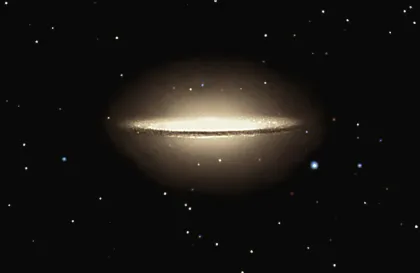
Out of This World

By Dave Trecker
Naples is full of remarkable people, and Ted Wolfe is one of them. In his working days, he was a successful businessman – “juiced up” you might say – the Executive Vice President of Welch Foods (Welch’s).
That’s pretty impressive in its own right. But what really stands out is what he did when he retired. No tennis or lazy days by the seashore for Ted. He became a shutterbug with a passion for outer space. He put together special camera equipment with telescopes and took pictures the likes of which most of us have never seen.
Ted tells how those photos differ from the ones I get with my Nikon.

Ted Wolfe
“A normal photo,” he says, “is a handheld or tripod-mounted shot of about a fraction of a second. My typical celestial photo, on the other hand, is a remotely operated image of about 7-12 hours total exposure time. It’s taken with an electronic camera cooled to -10 degrees Centigrade, mounted on a large telescope and driven by a professional tracking mount located 3,500 miles away at my observing site in the Atacama Desert in northern Chile – one of the darkest places on the planet.“
“A normal object would be something recognizable, like a sunset or a mountain or a lake. My object would be totally invisible to the naked eye and only about the size of the nail on your little finger held out at arm’s length from your body in the dead of night.”
The result of this fixation has become a second career for Ted, and a very successful one at that. It’s no exaggeration to say he is one of the top astrophotographers in the world.
It all started in 1995 when he constructed the first remote, robotic observatory in Florida. In 2016 he upped the ante and moved his equipment to Chile, from where he generated a remarkable portfolio of images from outer space.
One of those images was recently displayed at a Naples photo show. Called “Southern Pinwheel Galaxy,” the picture was the result of an 11-hour exposure made up of 75 eight-minute sub-exposures added together over several nights to bring out the stunning detail. Located in the Hydra constellation, the galaxy contains some 40 billion stars and is 15 million light years away (1 light year = 6 trillion miles).Staggering metrics for sure. It’s hard to wrap your mind around numbers that big.
But to Ted it’s second nature. He has cranked out virtually hundreds of celestial images – galaxies, nebulae, star clusters, planets, the moon, the sun and more.
To say he is well known in the trade would be an understatement. He has exhibited in museums, universities and institutions from Miami to the Canadian border. In Florida alone his work has been shown in science museums in Tampa, Orlando and Miami – topped off with a one-man, 20-month show at the Kennedy Space Center at Cape Canaveral. A permanent collection of his work is on display at the University of Florida in Gainesville.
And you can see his work online. His website at tedwolfe.com has been accessed by over 125,000 viewers.
If you haven’t logged in, try it. You won’t be disappointed. Ted Wolfe’s astrophotos are truly out of this world.
Dr. Trecker is a chemist and retired Pfizer executive living in Naples.


Leave a Reply
Want to join the discussion?Feel free to contribute!