
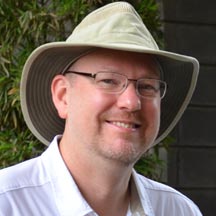
What Will They Say of Us by Tim L. Tetzlaff, Director of Conservation, Naples Zoo
 Over recent years, I’ve wrestled with some of my favorite quotes. In 1904, our gardens founder Dr. Henry Nehrling wrote that, “It is high time to protect and preserve what is still left in Florida.” I once put that on t-shirts for the zoo. As an appreciator of language, I had been struck by a 1906 quote by William Beebe, even had it on a t-shirt when I was a teenager: “The beauty and genius of a work of art may be reconceived, though its first material expression be destroyed; a vanished harmony may yet again inspire the composer, but when the last individual of a race of living things breathes no more, another heaven and another earth must pass before such a one can be again.” And Theodore Roosevelt, who had visited Nehrling’s garden in central Florida, told the nation in 1907 that, “the conservation of natural resources is the fundamental problem. Unless we solve that problem it will avail us little to solve all others.”
This salvo that opened the twentieth century was answered by many hands. Across the decades, numerous international treaties were enacted. Ivory trinkets and leopard fur coats faded from fashion. Laws were passed. Rivers flowed cleaner. Smog cleared from the skies over cities. That a Florida panther still wanders the pine flatwoods is a local testimony to those efforts.
Yet, we inherited less.
Even as we launched ourselves into the Space Age at Cape Canaveral, Floridians witnessed the last of their Ivory-billed woodpeckers, Caribbean monk seals, and too many others breathe no more. As eminent wildlife biologist George Schaller observed, “We cannot afford another century like this one.”
Nehrling’s vision to protect what remains is essential, but it is no longer enough. Indeed, despite Roosevelt’s caution, the lands and natural resources we depend on are not as they once were. Floridians know this all too well. While the world’s population quadrupled in the last century, Florida’s skyrocketed twentyfold. Our call is to return the abundance that once filled our skies, waters, and lands.
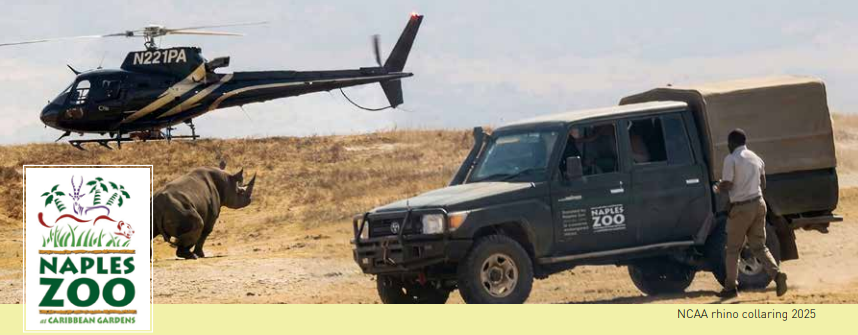
Over the last six years, I’ve been working with the leadership of Ngorongoro Conservation Area Authority to support black rhino conservation in its famed crater. Facing a poaching onslaught that dropped its rhino population from ten thousand to mere dozens, Tanzania had to stop the bleeding. That was crucial. But a healthy future isn’t an isolated population with no poaching. It’s the grander vision we’re pursuing of a restored landscape where rhinos can once again move naturally throughout the Serengeti-Mara Ecosystem.
Closer to home in Florida, our own Florida Wildlife Corridor faces similar challenges. The good news here is that most of the lands not under government protection are in agriculture. If they stay in agriculture, we keep our corridor. Over the last year, I’ve met with dozens of people and various groups working those lands to explore what they need to keep working lands working. Coming alongside them will be key to not only protect what we have but to help restore the abundance of our lands.
Recovery is a complex and daunting effort, even for the vision posted on my door: “Don’t think big. Think bigger.” It requires more than simply expanding the same tools, as essential as those remain. It means bringing more people into conservation conversations and supporting and learning from those already walking the new path. It means understanding human behavior as carefully as we study wildlife. It means breaking down “us versus them” thinking to stand shoulder to shoulder to rebuild what has been lost.
Our vision must be greater. Our methods must be greater. And our collaborations must be greater still. It is work we are committed to — but what we pass along to our children’s children will depend on many more hands joining to meet that challenge. I hope you’ll join with us. The words they speak of us at the end of this century will be the testimony to those efforts.
If you’d like to chat about joining and seeing where you’d fit in, reach out to tim@napleszoo.org.
Naples Zoo at Caribbean Gardens is a private 501(c)(3) nonprofit caring for rare species and welcoming families in a century-old historic garden. Since 2015, the zoo has invested more than $4.5 million in saving plants and animals in the wild and fully supports 35 field conservation staff working in seven countries.
www.napleszoo.org/conserve


Leave a Reply
Want to join the discussion?Feel free to contribute!