
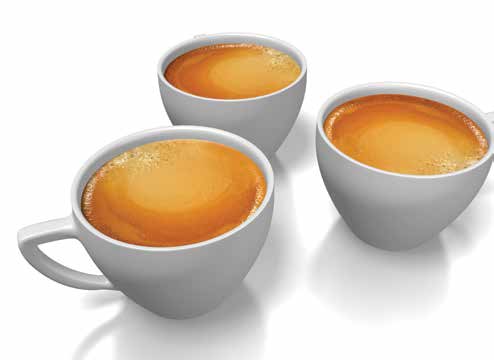
Three Cups A Day Keeps the Doctors Away
I love coffee, I love tea
I love the java jive
And it loves me.

By Dave Trecker
What’s the one thing we can’t do without? Coffee, of course. It gets us up in the mornings, kick starts meetings and drives us to the finish line at the end of the day. Two thirds of Americans consume it. Average intake is two cups of Joe per person per day. Floridians quaff much more. (We’re one of the biggest coffee-drinking states in the country.)
I’m addicted. I could quit drinking alcohol tomorrow, cold turkey. But not coffee.
And now I have another reasonto keep drinking it. Last summer, the American Heart Association reported that a carefully controlled study showed that downing 3 to 5 eight-ounce cups a day was linked to a lower risk of heart disease, cardio failure, stroke and Type 2 diabetes. This is a big deal and the most compelling scientific evidence yet of real health benefits.
There have been other claims over the years.
An extensive study showed a direct relationship between coffee drinking and longer life.
Regular intake was associated with an 18% lower risk of developing Alzheimers or Parkinsons.
An AHA investigation correlated consumption of coffee with reduced atrial fibrillation, blood clots and stroke.
Riding the wave of good news, java drinkers are consuming more and more of the good stuff. Working at home where the coffee pot is just a few steps away is credited with some of the increase. The U.S. National Coffee Association says 85% of coffee drinkers now take their Joe at home.
Why is it so good for you? Scientists list the reasons. One is that coffee is loaded with polyphenolics, chemicals that scarf up free radicals that promote inflammation and damage cells. Another is that caffeine binds to the adenosine receptors, freeing lots of feel-good dopamine.
But while we love it to death, java has downsides. Too much makes you jittery and irritable and keeps you up at night. It hit a low in 2018, when California threatened to list it as a carcinogen. That fear was put to bed only to be replaced by other worries, the worst being that coffee farming is an environmental disaster.
Turns out every two-cup-a-day coffee drinker requires continuous production from some 20 trees. To achieve that takes relentless fertilization, generating nutrients that trees suck out of the soil. As a result, plantations eventually become barren. Experts say in Brazil, the biggest producer, some 88% of the coffee land will be lost by 2050. Another problem is that harvesting and processing pour huge amounts of CO2 and other greenhouse gases into the atmosphere.
Then there’s the huge jolt in price, a knock-out punch at the supermarket, where coffee makes up as much as 20% of the average grocery bill. We espresso lovers pay even more. And U.S tariffs are pushing prices still higher, with increases approaching 30%.
How can we get costs down? Might “artificial” coffee be cheaper? Chemists have made some, crafting it from roasted date seeds and caffeine. Trouble is it tastes really terrible. Biologists tried another approach – fermentation of cells from coffee plants. That tastes a little better, but production costs are through the roof. The conclusion? At this writing, there is no substitute for the real thing.
Earlier this year lawmakers went about it differently. They introduced a bipartisan bill exempting coffee products from tariffs. That tells you something. Our lawmakers, who can’t agree on anything, do agree they can’t function without coffee.
I can’t either. So along with millions of others, I’m toughing it out and living with environmental damage and climate change and soaring prices. I’m accepting the sins and taking whatever I can get. And I’m never satisfied.
Like the song says, “I just can’t get enough of that wonderful stuff!”
Dr. Trecker is a chemist and retired Pfizerexecutive living in Naples.

Leave a Reply
Want to join the discussion?Feel free to contribute!