

Collier County Sheriff’s Office: Medical Readiness on Every Call
When emergencies strike, law enforcement is often the first to arrive — sometimes minutes before fire or EMS. That reality drives how Collier County Sheriff ’s Office deputies are trained, equipped and expected to respond.
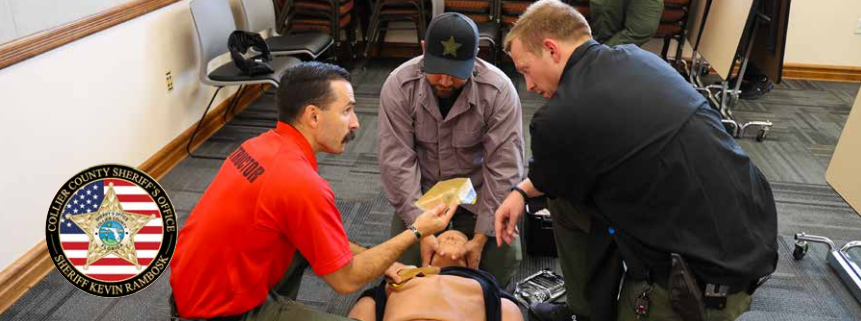
From opioid overdoses to cardiac arrest and from choking incidents to traumatic injuries, CCSO deputies receive advanced medical training that goes well beyond basic first aid. They also receive Tactical Emergency Casualty Care Training which provides them with the ability to effectively respond to any medical trauma emergency, mass casualty incident or active shooter incident they could be faced with. The goal is simple: stabilize patients and save lives until additional help arrives.
Sheriff Kevin Rambosk said the investment in training and equipment reflects the agency’s commitment to public safety and preservation of life.
“Our deputies are guardians in every sense of the word,” Sheriff Rambosk (FEATURED PHOTO) said. “They’re not just enforcing the law, they’re saving lives. We make sure they have the training and the tools to act immediately when seconds matter most.”
CCSO’s medical training philosophy is rooted in preparedness. Deputies regularly train in life-saving techniques, learning how to recognize medical distress, control severe bleeding, administer emergency medications, and use specialized equipment under pressure. According to CCSO medical training coordinator Dr John Ianni, every deputy must be ready for any call because emergencies don’t wait for the “right” responder. Deputies cannot assume someone else will arrive first. Whether it’s a traffic crash on a rural roadway, a school emergency, or a call inside a home, deputies must be capable of acting immediately and decisively.
“When we train together I tell our deputies this, ‘Band-Aids and gauze don’t fix bullet holes,” Dr. Ianni said. “Sadly, it’s the reality we face nowadays in law enforcement, but our deputies as well as other law enforcement officers across the nation are faced with new and ever-evolving dangers and circumstances. They must be ready to act at a moment’s notice, swiftly and sharply.”
To support that mission, CCSO patrol deputies are outfitted with state-of-the-art medical tools, many carried directly on their person and others stored in their patrol vehicles.
Among the tools deputies are equipped with are:
• Narcan (naloxone) carried on their person to reverse opioid overdoses
• AEDs (Automated External Defibrillators) in patrol vehicles to restore heart rhythm during cardiac emergencies
• LifeVac choking rescue devices in patrol vehicles to assist victims with airway obstructions
• Medical “go bags” in patrol vehicles, which include QuickClot combat gauze and tourniquets for severe bleeding; trauma dressings and bandages including chest seals, and protective medical gloves and supplies.
In the past year alone, CCSO deputies have saved dozens of lives using those tools and more. Dr. Ianni’s inbox is filled with testimonials from deputies who say the training and first-rate equipment provided by Sheriff Rambosk arms them with the skills and confidence to respond to any medical emergency they might encounter on the job. “I felt confident in my abilities on scene and thanks to the training staff, I was able to help a victim that was suffering from a serious injury,” wrote one deputy after he used his tourniquet and wound packing skills on a victim who had been stabbed multiple times.
Cpl. Richard Jacobs put his medical training to the test in 2024 when he was the first responder to a domestic-related shooting in Ave Maria. The 51-year-old victim had a gunshot wound to the chest. Cpl. Jacobs grabbed his Quickclot gauze from his Go Bag and began packing the wound. “I just kept stuffing the gauze into the wound until I couldn’t stuff anymore,” Cpl. Jacobs recalled.
He maintained pressure on the gauze in the wound until paramedics and firefighters arrived and took over care. His quick thinking and expert use of his CCSO medical training are credited with saving the victim’s life.
“I can say 100 percent the Casualty Care Training I received at the Collier County Sheriff ’s Office helped save this citizen’s life,” said Cpl. Jacobs.
Listen wherever you get your podcasts or stream it on SoundCloud.


Leave a Reply
Want to join the discussion?Feel free to contribute!