
Circumnavigating Wild and Wondrous Africa
 by Lisa Spiller, Luxury Travel Advisor
affiliated with Preferred Travel & Company.
Lisa@PreferredNaples.com
www.preferrednaples.com
If you haven’t been to Africa, it’s easy to miss just how vast and diverse the continent is. It isn’t a single, unified destination, but a mosaic of nations. By circumnavigating Africa and visiting ten countries, I came to appreciate how distinct each one is—shaped by its own colonial legacy, history, politics, language, and local culture.
Off of East Africa, the island nation of Mauritius surprised with modern high rises and highways, five-star beach resorts, and European heritage. It was colonized by the Netherlands, France and Great Britain and today, is a haven for offshore banking and European sun-seekers.
I boarded a motorboat captained by a dreadlocked millennial, and we skimmed across turquoise water toward a secluded island. The afternoon unfolded in easy indulgence—lounging in hammocks beneath whispering palms, sipping local beer and rum, and savoring grilled fresh catch alongside fragrant curries. A local guitarist sang French Calypso and hummed harmonica while we danced off lunch in the sunshine.
 Zanzibar, just off the coast of Tanzania, is a sublime fusion of powdery white beaches, lush jungles, playful monkeys, and a rich tapestry of Arab, Indian, African, and British influences in both architecture and culture.
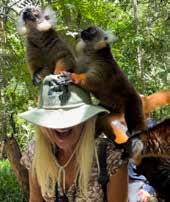
Here, I ventured into the Jozani Forest for a day of monkey trekking, coming face-to face with these mischievous primates for priceless photos. Bold and endlessly curious, they snatched sunglasses and seemed to revel in striking mesmerizing poses for the camera. At dusk, the bohemian-chic streets of Stone Town came alive. This beguiling UNESCO World Heritage city enchants with its whitewashed buildings, labyrinthine alleyways, artisan shops, inviting cafés, and intimate boutique hotels. We weaved through the alleyways, ducked into boutiques and courtyards and visited the Freddie Mercury Museum, a must-visit for any devoted Queen fan, before enjoying a sophisticated dinner on the sea wall under the stars.
Madagascar is a stark contrast to the emerging chic Zanzibar: raw, beautiful, and profoundly different from anywhere I had been before. It is also a place that requires emotional preparation; the visible poverty can be striking. We traveled by motorized canoe along a winding river where young boys balanced on hand-bound bamboo rafts to fish, cattle stood knee-deep in brown water alongside women washing their clothes, and daily life unfolded with quiet resilience.
 Walking the red, muddy paths of nearby villages, mothers crouched outside modest huts fashioned from branches and palm leaves, infants in their arms, while their toddlers eagerly hawked handcrafted goods; seed-bead jewelry, wood carvings, and beautifully woven baskets, hats, and purses.
Remarkably, the island is home to roughly 100 species of lemurs found nowhere else on earth. Hiking through the forests with a guide, we met dozens of these jungle dwellers—outrageously entertaining, surprisingly fearless and gentle. They swung effortlessly from the treetops onto our heads & shoulders, ate fruit from our hands and squabbled with each other for their share of our attention.
South Africa, at the tip of the continent, has it all: Modern lifestyle, historic British colonial charm, the Cape Town harbor dotted with outstanding restaurants, hotels and shops, natural wonders, colorful neighborhoods, wild ocean vistas, world-class golf and wildlife.
We stayed at my favorite hotel for sophisticated old-world glamour, the Belmond Mt. Nelson, and explored the city via Cape Sidecar Tours, a motorcycle adventure through city neighborhoods, up the coastal highway.
The winelands of Stellenbosch, Franschhoek and Paarl are 90 minutes from Cape Town and produce world-class Chardonnays, Cabs, and their local varietal, Pinotage. We tasted our way through Meerlust, Rupert & Rothschilds, Delaire Graff and Babylonstoren before heading out on safari. The heart and soul of South Africa is the wildlife, which is best experienced on a guided safari.
Kruger National Park in northeastern South Africa is one of Africa’s largest game reserves. Its high density of wild animals includes the Big 5: lions, leopards, rhinos, elephants and buffalos. However there are multiple private conservancies that offer heart – pumping encounters with lions, cheetah, giraffe, hyena, warthogs, water buffalo, zebra and hippo.
We indulged in four days of safari drives, which is never enough.
From South Africa, we traveled up the western coast of Africa to Namibia—a destination that surprised me more than any other. Once settled by Germans who claimed the mineral-rich coastline for diamond mining, the orderly, European architecture of Walvis Bay hints at those origins. The local entrepreneurs we encountered, many of European descent, had established boutique gin distilleries that welcome visitors for curated tastings and tours.
These experiences often extend beyond the distillery, pairing craft spirits with unforgettable coastal adventures—flamingo drives, kayaking and oyster foraging in the shallow lagoons.
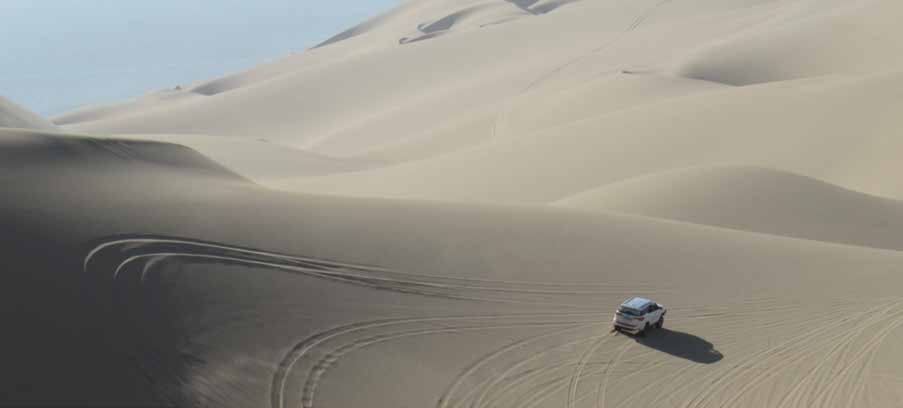
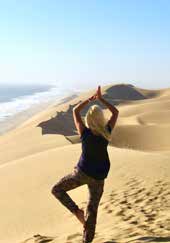
Namibia’s true star attraction, however, is its vast expanse of golden desert dunes, stretching from the Atlantic coast toward infinity and promising untamed adventure. Highly trained drivers bundled us into Range Rovers and launched us along the wild shoreline, then straight up and over the towering dunes for an adrenaline-charged ride that felt like a desert roller coaster.
We climbed razorback ridges, skimmed sandy peaks, plunged into shadowed valleys, and marveled at the drivers’ uncanny navigational skills—silently hoping they could, in fact, find our way back out. By day’s end, my fellow travelers and I agreed—this experience was an absolute must for any African adventure.
Continuing up Africa’s west coast from Namibia, we arrived in Angola—a nation shaped by its Portuguese heritage and unexpectedly defined by a skyline of coastal high-rises. Not a pretty city by any means, we were surprised to learn that Angola is the richest of African nations, with oil and diamonds leading the economy.
DeBeers has a strong presence here along with Sonangol Petrol which partners with Chevron. China has had a presence here for 100 years and is currently investing in the restoration of historic buildings and satellite infrastructure. China, it was noted, has a significant presence in “research and development” in every one of these African nations. Are you paying attention?
Further up the coast from Angola is Ghana, settled by the Dutch and British and now considered the most peaceful of African Nations, according to them. The red dirt streets of Ghana are a carnival of chaos, where donkey carts, ox-driven flatbeds, rickshaws, and foot traffic compete for space. Pedestrian merchants sell windshield wipers, produce and famously imaginative hand-carved fantasy coffins. Women weave between the chaos balancing antique sewing machines, eggs and plastic buckets of soda on their heads. Baboon families occupy the shoulders of paved country roads and camels loiter on construction sites.
From Ghana, we continued to Côte d’Ivoire—The Ivory Coast—a sovereign nation rather than a geographic region. My strongest impression was how distinctly strong the French influence is. English was rarely spoken, the rain fell in relentless sheets, and a thick layer of red dirt seemed to cling to everything, giving the landscape a raw, elemental quality.
I fell in love with Gambia. Once colonized by the British and independent since 1965, it is a place where Muslims and Christians live side by side in easy harmony. The air carries a fine dust, the streets hum with activity, and sleek Mercedes share the road with donkey carts. Concrete buildings, mid-rise malls, apartment blocks, and lively nightclubs create a cityscape that feels both industrious and evolving. Men dress in blue Jeans, T-shirts, and Chicago White Sox caps, while women dazzle in brilliantly colored African printed dresses and head wraps.
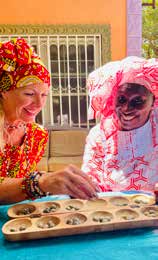
One of my most memorable experiences was joining a home cooking class hosted by an ambitious local entrepreneur educated in England and experienced in the hospitality industry. We wore beautiful African dresses sewn by her sister and prepared a meal together in her outdoor kitchen, using fresh shallots, tomatoes, peppers, peanuts, fish and chicken. After savoring our meal together, she taught us Mancala, a traditional African table game. That special afternoon remains one of my most cherished travel memories.
Further up the coast, Senegal bears the imprinted its French influence, yet its bustling street markets pulse with raw, unfiltered energy—dense with labor, heat, noise, and urgency. The atmosphere is intense and visceral, a sensory overload that feels worlds away from anything polished or restrained.
Beyond the city’s frenzy, we visited a rural village where the tribal chief welcomed us into his humble stick hut. We were greeted by his six wives and dozens of children, all who were lazily camped out on a mattress in the shade of the sand courtyard. The experience offered a striking glimpse into a way of life far removed from modern conveniences.
Unlike some places where joy seems to spill easily into the streets, the mood in Senegal felt sad and complex, reminding me that every country carries its own emotional landscape shaped by history and circumstance. Before departing, I purchased shell jewelry and hand painted bracelets crafted from recycled rubber, hoping my small contribution would help support the village families and honor the artisans’ work.
My experiences in Africa were both spellbinding and deeply eye-opening, offering a powerful glimpse into lives and realities far different from my own. They deepened my gratitude for the opportunities and freedoms I have known and reminded me never to take them for granted.

Leave a Reply
Want to join the discussion?Feel free to contribute!