
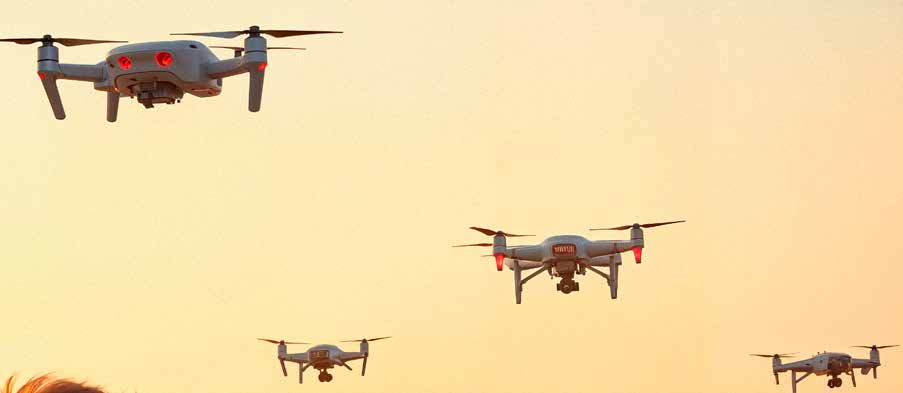
Drones. Drones. Everywhere.

By Dave Trecker
They are ubiquitous. Those annoying, buzzing things that look like mosquitoes from afar and come in all sizes and invade our lives in every way imaginable.
They’re called drones and they’ve been around for a long time.
The first recoverable “unmanned aerial vehicle” was developed just after World War I by the U.S. Navy and used sporadically in World War II. Mass production began in the early 1960s.
I first tried one about ten years ago, instructed by a son-in-law at the time who used it to snoop on neighbors and spot foxes in the adjoining woods at dusk. They are still available as toys. You can get a pretty good one from Amazon for under $500.
But drones are much more than toys now. When my wife and I sold our Naples house last year, our realtor used a drone tophotograph the property. Turns out that’s pro forma, part of the sales process for many single-family homes in Southwest Florida, part of the advertising shtick.
And weddings. I’m told wedding planners use them to record the festivities for later viewing – everything from the nuptials to the dancing to the rowdy behavior at night. It’s a new cottage industry.
And how about sports? Drones buzz about providing aerial views of baseball fields and soccer pitches, even indoor hockey rinks. We take them for granted, expecting no less for our TV viewing. Follow the long pass from above or watch the soccer kick leading to a breakaway. They’ve become a staple of sports journalism.
But that all pales compared to military use. A recent Wall Street Journal headline screamed, “Drones Redo Rules of War.” And they have done just that. Pentagon officials say they are the biggest battlefield innovation in a generation. Explosive-laden buzz flies.
Everyone has read of the audacious attack deep inside Russia last year by drones sneaked in by Ukraine to destroy Russian bombers. That was followed in short order by Israel taking out Iran’s air defenses with drone strikes.
What was less publicized was the massive use of drones by both sides. It’s not unusual now to read of thousands of drones being used by Russia and Ukraine at the same time and with frightening efficiency. Cost is of little concern, The small ones can be produced for well under $50,000, a far cry from the cost of a tank or a missile.
And it’s a winning strategy. According to the WSJ, drones have been three times more effective in inflicting casualties than all other weapons combined.
They’ve certainly changed the format for warfare. Today command centers are often made up of young videogame players. Top guns with computers. The days of the Red Baron are long gone. With drones fighting other drones in the air, quick reflexes are more important than military training.
A former videogame developer, a Ukrainian nicknamed Kratos, personally made over 380 confirmed drone interceptions last year. He was quoted in the WSJ as saying, “It is the stuff of movies, TV shows and books, but here we are in life and death situations everyday.”
Anduril Industries’ Christian Brose sees all of this as part of an ongoing revolution in military aircraft. The go-to, he says, will eventually be “vehicles half the size of fighter jets with business jet engines in back – much larger than what comes to mind when we hear the word ‘drone.’”
These newer, more destructive robots will be able to carry heavier payloads and fly them greater distances than ever before, turning a tactical weapon into a strategic one for only modestly more cost. Drones will soon become global weapons. A six-hour flight is said to be within reach.
Is this worrisome? You bet.
James Rogers, a drone expert at Cornell University, was quoted by the WSJ as saying, “Cheap, long-range saturation strikes are one of the greatest threats to international security today.”
Dr. Trecker is a chemist and retired Pfizer executive living in Naples.


Leave a Reply
Want to join the discussion?Feel free to contribute!