


Page 72 - LIN_MJJ_2026__web-file
P. 72
health & fitness


           The Importance of Rib Cage Mobility


        by Paula Allia, PT, DHSc, MTC, OCS
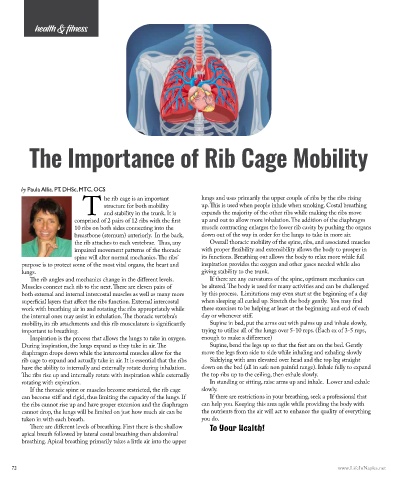
                                   he rib cage is an important     lungs and uses primarily the upper couple of ribs by the ribs rising
                                   structure for both mobility     up. This is used when people inhale when smoking. Costal breathing
                            T and stability in the trunk. It is    expands the majority of the other ribs while making the ribs move
                         comprised of 2 pairs of 12 ribs with the first   up and out to allow more inhalation. The addition of the diaphragm
                         10 ribs on both sides connecting into the   muscle contracting enlarges the lower rib cavity by pushing the organs
                         breastbone (sternum) anteriorly.  In the back,   down out of the way in order for the lungs to take in more air.
                         the rib attaches to each vertebrae.  Thus, any   Overall thoracic mobility of the spine, ribs, and associated muscles
                         impaired movement patterns of the thoracic   with proper flexibility and extensibility allows the body to prosper in
                         spine will alter normal mechanics. The ribs’   its functions. Breathing out allows the body to relax more while full
        purpose is to protect some of the most vital organs, the heart and   inspiration provides the oxygen and other gases needed while also
        lungs.                                                     giving stability to the trunk.
           The rib angles and mechanics change in the different levels.   If there are any curvatures of the spine, optimum mechanics can
        Muscles connect each rib to the next. There are eleven pairs of   be altered. The body is used for many activities and can be challenged
        both external and internal intercostal muscles as well as many more   by this process.  Limitations may even start at the beginning of a day
        superficial layers that affect the ribs function. External intercostal   when sleeping all curled up. Stretch the body gently.  You may find
        work with breathing air in and rotating the ribs appropriately while   these exercises to be helping at least at the beginning and end of each
        the internal ones may assist in exhalation. The thoracic vertebra’s   day or whenever stiff.
        mobility, its rib attachments and this rib musculature is significantly   Supine in bed, put the arms out with palms up and inhale slowly,
        important to breathing.                                    trying to utilize all of the lungs over 5-10 reps. (Each ex of 3-5 reps,
           Inspiration is the process that allows the lungs to take in oxygen.   enough to make a difference)
        During inspiration, the lungs expand as they take in air. The   Supine, bend the legs up so that the feet are on the bed. Gently
        diaphragm drops down while the intercostal muscles allow for the   move the legs from side to side while inhaling and exhaling slowly
        rib cage to expand and actually take in air. It is essential that the ribs   Sidelying with arm elevated over head and the top leg straight
        have the ability to internally and externally rotate during inhalation.   down on the bed (all in safe non painful range). Inhale fully to expand
        The ribs rise up and internally rotate with inspiration while externally   the top ribs up to the ceiling, then exhale slowly.
        rotating with expiration.                                     In standing or sitting, raise arms up and inhale.  Lower and exhale
           If the thoracic spine or muscles become restricted, the rib cage   slowly.
        can become stiff and rigid, thus limiting the capacity of the lungs. If   If there are restrictions in your breathing, seek a professional that
        the ribs cannot rise up and have proper excursion and the diaphragm   can help you. Keeping this area agile while providing the body with
        cannot drop, the lungs will be limited on just how much air can be   the nutrients from the air will act to enhance the quality of everything
        taken in with each breath.                                 you do.
           There are different levels of breathing. First there is the shallow   To Your Health!
        apical breath followed by lateral costal breathing then abdominal
        breathing. Apical breathing primarily takes a little air into the upper


     72                                                                                                        www.LifeInNaples.net

