


Page 27 - LIN_MJJ_2026__web-file
P. 27
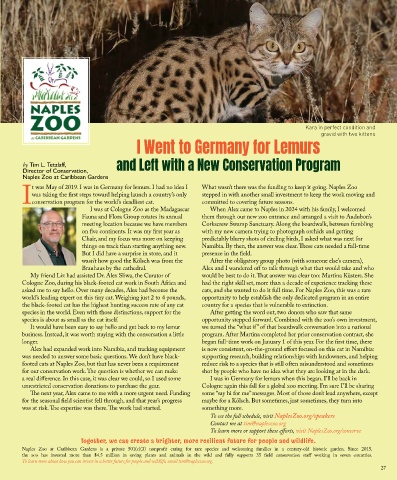
Kara in perfect condition and
                                                                                                          gravid with two kittens
                                              I Went to Germany for Lemurs


        by Tim L. Tetzlaff,            and Left with a New Conservation Program
        Director of Conservation,
        Naples Zoo at Caribbean Gardens

           t was May of 2019. I was in Germany for lemurs. I had no idea I   What wasn’t there was the funding to keep it going. Naples Zoo
           was taking the first steps toward helping launch a country’s only   stepped in with another small investment to keep the work moving and
        Iconservation program for the world’s deadliest cat.       committed to covering future seasons.
                              I was at Cologne Zoo as the Madagascar   When Alex came to Naples in 2024 with his family, I welcomed
                            Fauna and Flora Group rotates its annual   them through our new zoo entrance and arranged a visit to Audubon’s
                            meeting location because we have members   Corkscrew Swamp Sanctuary. Along the boardwalk, between fumbling
                            on five continents. It was my first year as   with my new camera trying to photograph orchids and getting
                            Chair, and my focus was more on keeping   predictably blurry shots of circling birds, I asked what was next for
                            things on track than starting anything new.   Namibia. By then, the answer was clear. These cats needed a full-time
                            But I did have a surprise in store, and it   presence in the field.
                            wasn’t how good the Kölsch was from the   After the obligatory group photo (with someone else’s camera),
                            Brauhaus by the cathedral.             Alex and I wandered off to talk through what that would take and who
           My friend Liz had assisted Dr. Alex Sliwa, the Curator of   would be best to do it. That answer was clear too: Martina Küsters. She
        Cologne Zoo, during his black-footed cat work in South Africa and   had the right skill set, more than a decade of experience tracking these
        asked me to say hello. Over many decades, Alex had become the   cats, and she wanted to do it full time. For Naples Zoo, this was a rare
        world’s leading expert on this tiny cat. Weighing just 2 to 4 pounds,   opportunity to help establish the only dedicated program in an entire
        the black-footed cat has the highest hunting success rate of any cat   country for a species that is vulnerable to extinction.
        species in the world. Even with those distinctions, support for the   After getting the word out, two donors who saw that same
        species is about as small as the cat itself.               opportunity stepped forward. Combined with the zoo’s own investment,
           It would have been easy to say hello and get back to my lemur   we turned the “what if” of that boardwalk conversation into a national
        business. Instead, it was worth staying with the conversation a little   program. After Martina completed her prior conservation contract, she
        longer.                                                    began full-time work on January 1 of this year. For the first time, there
           Alex had expanded work into Namibia, and tracking equipment   is now consistent, on-the-ground effort focused on this cat in Namibia:
        was needed to answer some basic questions. We don’t have black-  supporting research, building relationships with landowners, and helping
        footed cats at Naples Zoo, but that has never been a requirement   reduce risk to a species that is still often misunderstood and sometimes
        for our conservation work. The question is whether we can make   shot by people who have no idea what they are looking at in the dark.
        a real difference. In this case, it was clear we could, so I used some   I was in Germany for lemurs when this began. I’ll be back in
        unrestricted conservation donations to purchase the gear.  Cologne again this fall for a global zoo meeting. I’m sure I’ll be sharing
           The next year, Alex came to me with a more urgent need. Funding   some “say hi for me” messages. Most of those don’t lead anywhere, except
        for the seasonal field scientist fell through, and that year’s progress   maybe for a Kölsch. But sometimes, just sometimes, they turn into
        was at risk. The expertise was there. The work had started.    something more.
                                                                      To see the full schedule, visit NaplesZoo.org/speakers
                                                                      Contact me at tim@napleszoo.org
                                                                      To learn more or support these efforts, visit NaplesZoo.org/conserve
                           Together, we can create a brighter, more resilient future for people and wildlife.
        Naples Zoo at Caribbean Gardens is a private 501(c)(3) nonprofit caring for rare species and welcoming families in a century-old historic garden. Since 2015,
        the zoo has invested more than $4.5 million in saving plants and animals in the wild and fully supports 35 field conservation staff working in seven countries.
        To learn more about how you can invest in a better future for people and wildlife, email tim@napleszoo.org.
                                                                                                                             27
     Life in Naples | May-June-July 2026                                                                                     27

