


Page 27 - LIN_March_2026_Web-File
P. 27
The National Geographic Explorer


        by Tim L. Tetzlaff,              Sitting Near You at Tin City
        Director of Conservation,
        Naples Zoo at Caribbean Gardens

                 e were having dinner at Tin City when a young lady   Over the years, I’ve watched students ask questions you’d never
                 walked up to our table. Quietly, she asked my friend, “Are   imagine a nine-year-old could fathom—about behavior, genetics, and
        Wyou Luke Dollar?” Her parents were a step behind, phone   conservation—alongside simpler ones, like what language people speak
                            in hand to take the picture she asked for   in Madagascar (Malagasy and French, by the way). Luke has now visited
                            with this scientist. As Luke smiled for the   every elementary school in the county, and we’re over halfway through
                            photo, he asked, “Are you in fourth grade?”   to doing that twice. I’ve seen hallways decorated for a hundred feet in
                            She shook her head. “Fifth.”           all things Madagascar and listened to a poem written by a student about
                              That moment doesn’t really make sense   Luke that brought both of us to tears.
                            unless you understand what came before it.  Building on Luke’s impact, this program is now known as ZooCon
                              Back in 2013, a colleague with Collier   and has expanded to reach about 20,000 students each year, from
                            County Public Schools asked me a simple   kindergarten through fifth grade. Students now virtually meet and speak
                            question: “You know Luke Dollar. Do you   with Florida scientists who study panthers, alligators, and black bears, as
        think he would come here?” At the time, Luke was the scientist   well as international conservation leaders working with African lions and
        featured on the cover of a National Geographic science textbook   giraffes—experts logging on from as far away as Nairobi. It has become
        used by local fourth graders. Students were already learning the   a single, connected conversation that grows with students as they move
        scientific method by following his fieldwork in Madagascar.   through elementary school.
           I had known Luke for years and Naples Zoo was already a long-  My favorite ZooCon story reminds me of the Coca Cola commercial
        term supporter of his work in Madagascar. Over time, that support   with Mean Joe Greene from 1979. One year, Luke was flying home
        grew into fully funding six members of his conservation team there.   with a connection through Atlanta. A fourth grader on the flight with
        When asked to speak directly with students, Luke immediately said   his family recognized him and introduced himself. During the trip,
        yes. As a professor and now a department chair, education is core to   Luke answered questions, pulled up photos on his laptop, and shared
        who he is. In Madagascar, that commitment has included building   stories from the field. As they parted ways, Luke reached up, took off his
        schools, two of which we funded.                           National Geographic baseball cap, and tossed it over to the boy.
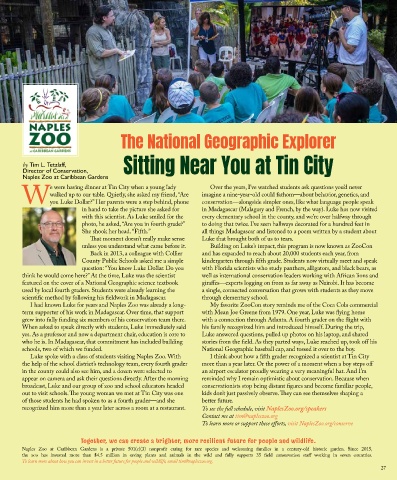
           Luke spoke with a class of students visiting Naples Zoo. With   I think about how a fifth grader recognized a scientist at Tin City
        the help of the school district’s technology team, every fourth grader   more than a year later. Or the power of a moment when a boy steps off
        in the county could also see him, and a dozen were selected to   an airport escalator proudly wearing a very meaningful hat. And I’m
        appear on camera and ask their questions directly. After the morning   reminded why I remain optimistic about conservation. Because when
        broadcast, Luke and our group of zoo and school educators headed   conservationists stop being distant figures and become familiar people,
        out to visit schools. The young woman we met at Tin City was one   kids don’t just passively observe. They can see themselves shaping a
        of those students he had spoken to as a fourth grader—and she   better future.
        recognized him more than a year later across a room at a restaurant.  To see the full schedule, visit NaplesZoo.org/speakers
                                                                   Contact me at tim@napleszoo.org
                                                                   To learn more or support these efforts, visit NaplesZoo.org/conserve

                           Together, we can create a brighter, more resilient future for people and wildlife.
        Naples Zoo at Caribbean Gardens is a private 501(c)(3) nonprofit caring for rare species and welcoming families in a century-old historic garden. Since 2015,
        the zoo has invested more than $4.5 million in saving plants and animals in the wild and fully supports 35 field conservation staff working in seven countries.
        To learn more about how you can invest in a better future for people and wildlife, email tim@napleszoo.org.
                                                                                                                             27
     Life in Naples | March 2026                                                                                             27

