


Page 27 - LINDec2025-webfile++++
P. 27
Athena’s Story:


         One Kitten’s Journey,


          One Species’ Future


        by Tim L. Tetzlaff,
        Director of Conservation,
        Naples Zoo at Caribbean Gardens
                                   few days before writing this, I helped
                                   carry a Florida panther into the
                            A Glass Animal Hospital, one of many
                            that have arrived with little notice over the
                            years. Panther response is rarely scheduled.
                              Back in June 2017, we had a meeting
                            with filmmaker Chris Morgan about creating
                            a panther documentary with Big Cypress
                            National Preserve. Tammy Whittington, the
        park’s superintendent at the time, arrived with a kitten in her arms.
        While she bottle-fed the tiny cat, Chris discussed filming logistics. That
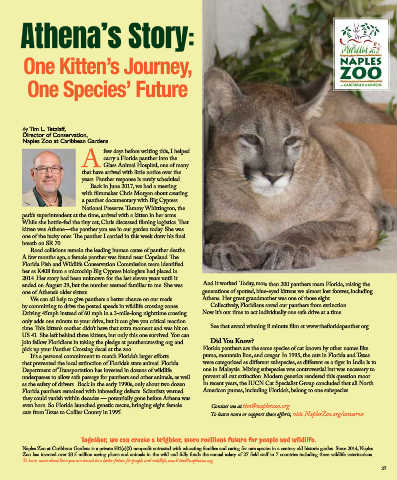
        kitten was Athena—the panther you see in our garden today. She was
        one of the lucky ones. The panther I carried in this week drew his final
        breath on SR 70.
           Road collisions remain the leading human cause of panther deaths.
        A few months ago, a female panther was found near Copeland. The
        Florida Fish and Wildlife Conservation Commission team identified
        her as K408 from a microchip Big Cypress biologists had placed in
        2014. Her story had been unknown for the last eleven years until it
        ended on August 29, but the number seemed familiar to me. She was   And it worked. Today, more than 200 panthers roam Florida, raising the
        one of Athena’s older sisters.                             generations of spotted, blue-eyed kittens we almost lost forever, including
           We can all help to give panthers a better chance on our roads   Athena. Her great grandmother was one of those eight.
        by committing to drive the posted speeds in wildlife crossing zones.   Collectively, Floridians saved our panthers from extinction.
        Driving 45mph instead of 60 mph in a 3-mile-long nighttime crossing   Now it’s our time to act individually one safe drive at a time.
        only adds one minute to your drive, but it can give you critical reaction
        time. This kitten’s mother didn’t have that extra moment and was hit on   See that award winning 8 minute film at www.thefloridapanther.org.
        US 41. She left behind three kittens, but only this one survived. You can
        join fellow Floridians in taking the pledge at panthercrossing.org and   Did You Know?
        pick up your Panther Crossing decal at the zoo.            Florida panthers are the same species of cat known by other names like
           It's a personal commitment to match Florida’s larger efforts   puma, mountain lion, and cougar. In 1995, the cats in Florida and Texas
        that prevented the local extinction of Florida’s state animal. Florida   were categorized as different subspecies, as different as a tiger in India is to
        Department of Transportation has invested in dozens of wildlife   one in Malaysia. Mixing subspecies was controversial but was necessary to
        underpasses to allow safe passage for panthers and other animals, as well   prevent all out extinction. Modern genetics rendered this question moot.
        as the safety of drivers.  Back in the early 1990s, only about two dozen   In recent years, the IUCN Cat Specialist Group concluded that all North
        Florida panthers remained with inbreeding defects. Scientists warned   American pumas, including Florida’s, belong to one subspecies.
        they could vanish within decades — potentially gone before Athena was
        even born. So Florida launched genetic rescue, bringing eight female   Contact me at tim@napleszoo.org
        cats from Texas to Collier County in 1995.                    To learn more or support these efforts, visit NaplesZoo.org/conserve


                           Together, we can create a brighter, more resilient future for people and wildlife.
        Naples Zoo at Caribbean Gardens is a private 501(c)(3) nonprofit entrusted with educating families and caring for rare species in a century old historic garden. Since 2014, Naples
        Zoo has invested over $3.5 million saving plants and animals in the wild and fully funds the annual salary of 27 field staff in 7 countries including three wildlife veterinarians.
        To learn more about how you can invest in a better future for people and wildlife, email tim@napleszoo.org.
                                                                                                                             27
     Life in Naples | December 2025                                                                                          27

