


Page 26 - November2026LifeInNaples
P. 26
Nine Thousand Miles


              for Fifteen Minutes
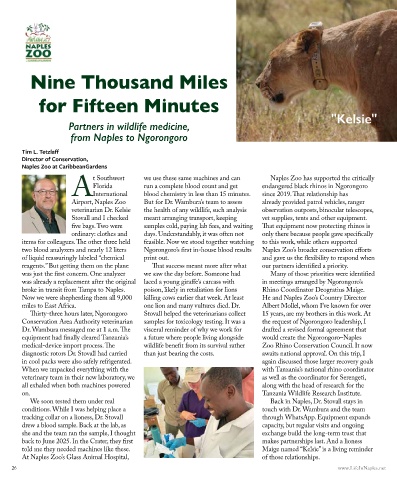
                                                                                                             "Kelsie"
                       Partners in wildlife medicine,

                        from Naples to Ngorongoro

        Tim L. Tetzlaff
        Director of Conservation,
        Naples Zoo at CaribbeanGardens

                               t Southwest      we use these same machines and can       Naples Zoo has supported the critically
                               Florida          run a complete blood count and get     endangered black rhinos in Ngorongoro
                        AInternational          blood chemistry in less than 15 minutes.   since 2019. That relationship has
                        Airport, Naples Zoo     But for Dr. Wambura’s team to assess   already provided patrol vehicles, ranger
                        veterinarian Dr. Kelsie   the health of any wildlife, such analysis   observation outposts, binocular telescopes,
                        Stovall and I checked   meant arranging transport, keeping     vet supplies, tents and other equipment.
                        five bags. Two were     samples cold, paying lab fees, and waiting   That equipment now protecting rhinos is
                        ordinary: clothes and   days. Understandably, it was often not   only there because people gave specifically
        items for colleagues. The other three held   feasible. Now we stood together watching  to this work, while others supported
        two blood analyzers and nearly 12 liters   Ngorongoro’s first in-house blood results   Naples Zoo’s broader conservation efforts
        of liquid reassuringly labeled “chemical   print out.                          and gave us the flexibility to respond when
        reagents.” But getting them on the plane   That success meant more after what   our partners identified a priority.
        was just the first concern. One analyzer   we saw the day before. Someone had    Many of those priorities were identified
        was already a replacement after the original   laced a young giraffe’s carcass with   in meetings arranged by Ngorongoro’s
        broke in transit from Tampa to Naples.   poison, likely in retaliation for lions   Rhino Coordinator Deogratius Maige.
        Now we were shepherding them all 9,000   killing cows earlier that week. At least   He and Naples Zoo’s Country Director
        miles to East Africa.                   one lion and many vultures died. Dr.   Albert Mollel, whom I’ve known for over
           Thirty-three hours later, Ngorongoro   Stovall helped the veterinarians collect   15 years, are my brothers in this work. At
        Conservation Area Authority veterinarian   samples for toxicology testing. It was a   the request of Ngorongoro leadership, I
        Dr. Wambura messaged me at 1 a.m. The   visceral reminder of why we work for   drafted a revised formal agreement that
        equipment had finally cleared Tanzania’s   a future where people living alongside   would create the Ngorongoro–Naples
        medical-device import process. The      wildlife benefit from its survival rather   Zoo Rhino Conservation Council. It now
        diagnostic rotors Dr. Stovall had carried   than just bearing the costs.       awaits national approval. On this trip, I
        in cool packs were also safely refrigerated.                                   again discussed those larger recovery goals
        When we unpacked everything with the                                           with Tanzania’s national rhino coordinator
        veterinary team in their new laboratory, we                                    as well as the coordinator for Serengeti,
        all exhaled when both machines powered                                         along with the head of research for the
        on.                                                                            Tanzania Wildlife Research Institute.
           We soon tested them under real                                                Back in Naples, Dr. Stovall stays in
        conditions. While I was helping place a                                        touch with Dr. Wambura and the team
        tracking collar on a lioness, Dr. Stovall                                      through WhatsApp. Equipment expands
        drew a blood sample. Back at the lab, as                                       capacity, but regular visits and ongoing
        she and the team ran the sample, I thought                                     exchange build the long-term trust that
        back to June 2025. In the Crater, they first                                   makes partnerships last. And a lioness
        told me they needed machines like these.                                       Maige named “Kelsie” is a living reminder
        At Naples Zoo’s Glass Animal Hospital,                                         of those relationships.
     26                                                                                                        www.LifeInNaples.net

